
Beyond Diplomacy: Kenya and France Reimagine Strategic Partnership in a shifting Global Order
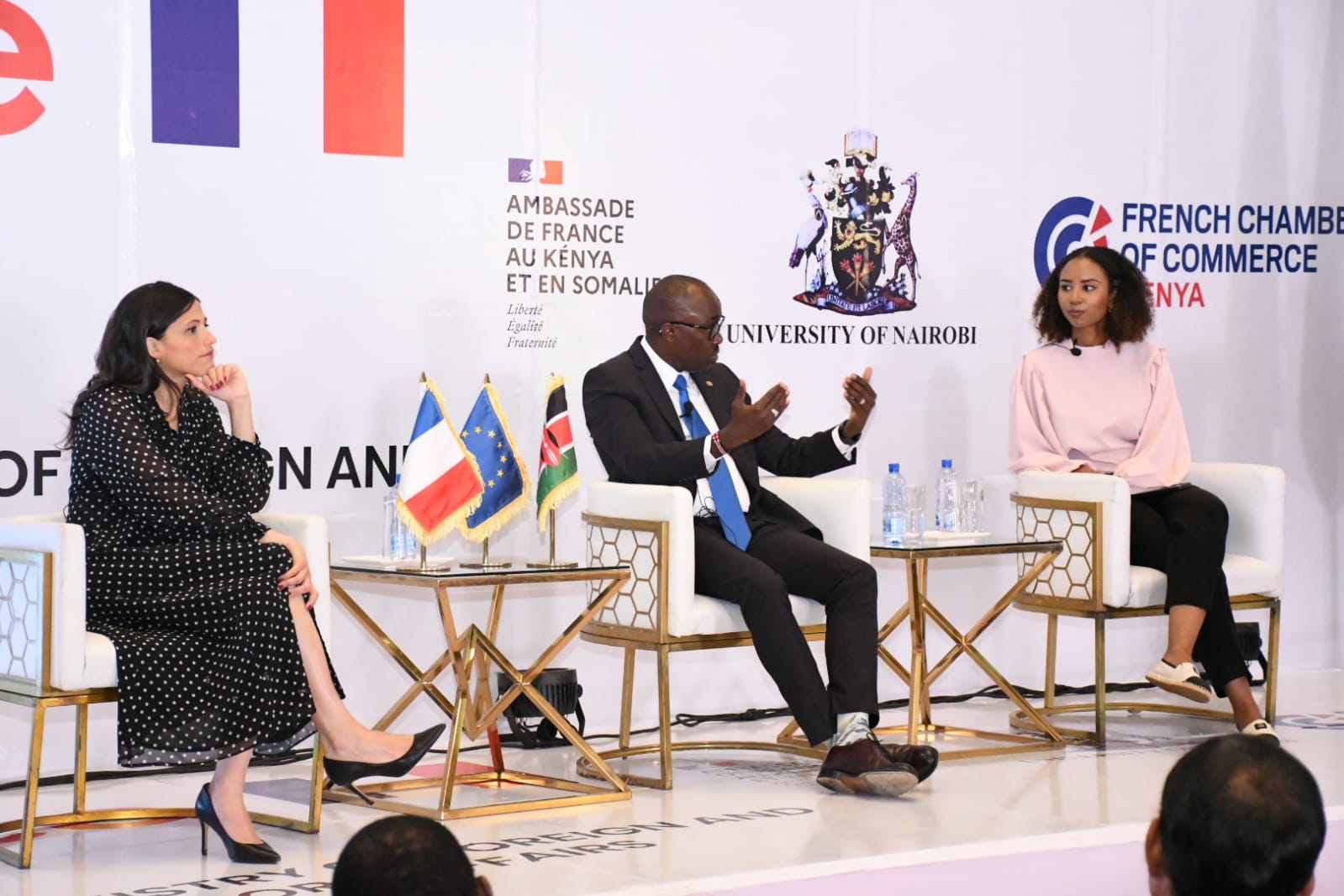
Kenya France Diplomatic Relations at UoN
What does a strategic partnership look like in a world where multilateralism is under strain, climate disruptions are intensifying, and global alliances are shifting in real time?
This question framed a high-level engagement at the University of Nairobi’s Jomo Kenyatta Memorial Library, on Friday 13, 2026, where Kenya and France reflected not only on the state of their bilateral ties, but also the future of diplomacy itself.
Can multilateralism be reformed rather than abandoned? Can partnerships be equitable rather than extractive? Can Africa shape the architecture of global governance instead of merely responding to it?
When Minister Delegate for Francophonie and International Partnerships, H.E. Éléonore Caroit, took the floor, she expanded the conversation outward situating Kenya within France’s evolving global strategy. Kenya, she indicated, is viewed not only as a regional anchor in East Africa but as a strategic gateway linking Africa to the Indo-Pacific. With over 140 French firms operating in Kenya and creating thousands of jobs, economic ties are already substantial. The future lies in deepening cooperation across climate action, health security, infrastructure, renewable energy, digital innovation, and the blue economy, she suggested.
The urgency was sharpened by Kenya’s Principal Secretary for Foreign and Diaspora Affairs, Dr Korir Sing’Oei, who framed the discussion in stark global terms. The global order, he observed, is under severe strain shaken by successive crises, declining solidarity, and weakening multilateral institutions. “No matter how difficult the obstacles are, isolation is not a solution,” he said. “We must collaborate and develop new, more effective approaches.” He positioned the Kenya–France relationship as an example of constructive cooperation grounded in shared values: respect for international law, sustainable development, education, and youth engagement.
Welcoming guests on behalf of the Vice Chancellor, Deputy Vice Chancellor for Finance, Planning and Development,Prof. Jackson Maalu reminded the audience that the venue itself carries history. “He described France as a longstanding and strategic academic partner of the University of Nairobi. From the Engineering and Science Complex to collaborations in agriculture, business, and social sciences, partnerships with institutions such as Paris-Saclay, PSL, Sciences Po, Nice Côte d’Azur, and Montpellier have become part of the university’s transformation agenda. Supported by the French Embassy, Campus France, AFD and Expertise France, he pointed out how these initiatives embody cooperation that serves joint interests in a win-win spirit.“ In this fractured world,” he added, echoing the conference theme, “it is more than needed… it is essential.”
Speaking about the historical value of the venue, ‘This place has seen so many students, including your Excellency Principal Secretary, welcome back home,” he said warmly, drawing light laughter. The moment grounded the high-level diplomatic exchange in something personal: shared spaces, shared memories, and shared futures.’
The upcoming Africa Forward Summit in Nairobi, scheduled for May 2026 in Nairobi, was framed as an opportunity to rebalance financial systems, promote sustainable investment, and ensure that African voices shape global conversations. Both Speakers agreed that the Summit represents more than another diplomatic convening. It is an attempt to reshape how Africa and its partners define cooperation with financial reform, energy transition, digital innovation, and the blue economy high on the agenda.
One recurring theme was youth. Africa’s demographic trajectory is not simply a statistic; it is a strategic reality. Minister Caroit encouraged young people to view global uncertainty not only as risk, but as opportunity, a space for innovation, solidarity, and co-creation. The emphasis was not symbolic inclusion, but meaningful participation in program design, policy conversations, and cross-border collaboration.
In Nairobi, within the walls of a library that has witnessed generations of students pass through its doors, those questions felt less rhetorical and more urgent.If the world is indeed fractured, the work ahead will not be to restore the past but to construct something more balanced, more inclusive, and more resilient in its place.

